Flooring6 min read
How thick should an epoxy floor be: coating to screed
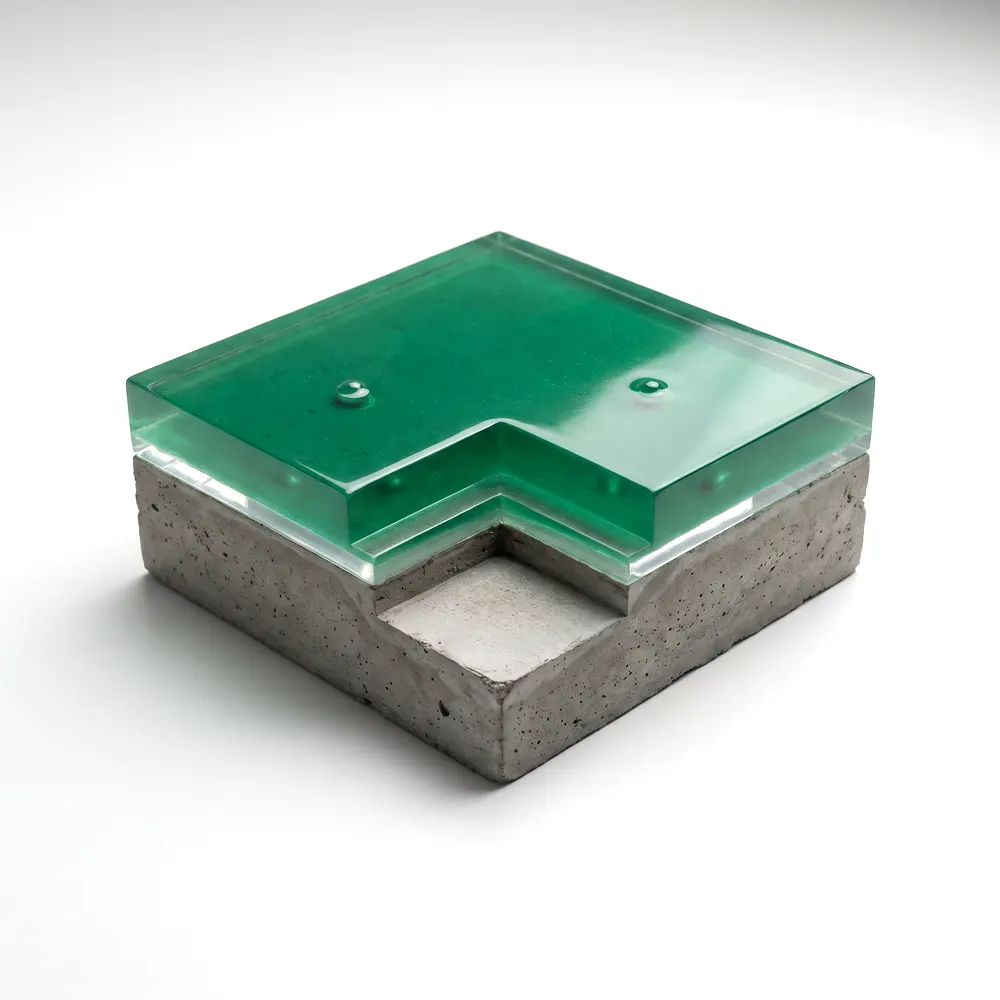
A resin floor can be anything from a 150 micron seal to a screed over 6 mm thick. FeRFA's classification puts floor coatings under 1 mm, flow-applied floors at 2 to 3 mm and heavy-duty flowable floors at 4 to 6 mm. Choose the band from the duty, the flatness of the slab and any hot spills, then check that the product's data sheet actually states that thickness.
In this guide
How thick is an epoxy floor in millimetres?
It depends on the type of floor: the published bands run from 0.15 mm to over 6 mm. The clearest reference is FeRFA, the UK resin flooring association, which sorts resin floors into eight types by thickness and duty.
The last column below shows where a stocked product's own data sheet puts it in a band. These are matches we made by thickness. No sheet names a FeRFA type, so a band is a guide and not a certificate.
"Not stated" is the honest entry for most rows. Mapefloor FC 200 ME is sold as a high build coating, but its sheet prints kilograms per square metre and no film thickness. X-Tech EpoxyFloor SL1 at 1 to 1.5 mm starts at the top of type 3 and runs past it. If a quotation says "epoxy flooring" with no thickness, ask which one you are buying. The Mapei products are on our resin flooring line, with the data sheet on each page.
| FeRFA type | Thickness | Typical duty | Stocked product stating it |
|---|---|---|---|
| 1 Floor seal | 150 microns | Light | Not stated |
| 2 Floor coating | 150 to 300 microns | Light to medium | Not stated |
| 3 High build coating | 300 to 1000 microns | Medium | X-Tech EpoxyFloor SL1 at 1 mm |
| 4 Multi-layer | Over 2 mm | Medium to heavy | Not stated |
| 5 Flow applied | 2 to 3 mm | Medium to heavy | Mapefloor I 300 SL ME (2 to 4 mm) |
| 6 Resin screed | Over 4 mm | Medium to heavy | Not stated |
| 7 Heavy duty flowable | 4 to 6 mm | Heavy to very heavy | Mapefloor CPU+/MF (3 to 6 mm) |
| 8 Heavy duty resin | Over 6 mm | Very heavy | Not stated |
What is the difference between an epoxy coating and a self-levelling floor?
A coating is rolled on and follows the slab; a self-levelling floor is poured, spread and finds its own surface. Mapefloor FC 200 ME is the rolled kind: two coats at 0.32 kg/m² each. Its sheet prints no thickness, but it does print a mix density of 1.50, so a calculated wet film is 0.32 ÷ 1.50 = about 0.21 mm per coat, or about 0.43 mm for two. That is our arithmetic, not Mapei's figure.
Mapefloor I 300 SL ME is poured, spread with a notched trowel and back-rolled with a spiked roller. Its text says 2 to 4 mm. The title line of the same sheet says 1 to 4 mm; we use the figure from the technical section. X-Tech EpoxyFloor SL1 is the thinner self-smoothing option, at 1 to 1.5 mm.
A cement self-leveller is a different material. Ultraplan Eco 20 goes down at 1 to 10 mm per layer, indoors only, to prepare a floor for a finish. It is a smoothing layer, not a resin floor.
What does a thicker floor actually buy?
It buys tolerance of an uneven slab, of heat and of heavier duty, rather than a stronger material. Take heat first, because one sheet prints it plainly. Mapefloor CPU+/MF lists its resistance to thermal shock, such as hot liquid spills, by thickness: -10°C up to +60°C at 3 mm, -15°C up to +70°C at 4 mm, and -25°C up to +80°C at 6 mm.
Flatness is the second reason. FeRFA's normal surface regularity class for commercial and industrial use, SR2, allows 5 mm under a 2 m straightedge. A 1 mm floor cannot take out a 5 mm hollow; it follows it. Primer SN can take up to 50% by weight of quartz sand to even out a rough surface, and Mapefloor CPU+/MF prints a 1 mm scratch coat at about 1.7 kg/m².
Strength is what thickness does not change on paper. Mapefloor I 300 SL ME prints one compressive strength, 50 N/mm², with no thickness attached to it.
How do you choose a thickness for the traffic?
Start from the duty band, then read the uses printed on the sheet, because no source we have gives a thickness per vehicle. FeRFA uses words from light to very heavy, not forklift weights, and we will not invent a conversion. For forklifts, take the axle loads to Mapei technical services.
The sheets do narrow the choice. Mapefloor FC 200 ME names warehouses, factories, hangars, workshops and garages, and is set to vehicular traffic at 48 hours. Mapefloor I 300 SL ME names mechanised warehouses, laboratories and hospitals. Mapefloor CPU+/MF names dairies, meat and fish processing, commercial kitchens and freezing rooms, wherever hot liquids reach the floor.
Thickness will not rescue a weak slab. The sheets ask for at least 25 N/mm² compressive and 1.5 N/mm² tensile, and Mapefloor FC 200 ME adds that the substrate must also suit the loads it will carry. Thicker systems also add site work: anchoring grooves for Mapefloor CPU+/MF must be about double the mortar thickness, in both depth and width.
How does thickness change the material you need?
Material rises with thickness, and the jump between floor types is large. For a self-levelling floor, mass per square metre is the mix density multiplied by the thickness: Mapefloor I 300 SL ME's printed 3.7 kg/m² is its density of 1.85 × 2 mm, so the sheet's figures agree. Doubling to 4 mm gives a calculated 1.85 × 4 = 7.4 kg/m². That figure is ours; the sheet prints only the 2 mm rate.
The table shows printed rates only. Mapefloor CPU+/MF is the exception to neat arithmetic: 6 mm is twice 3 mm, but 10 kg/m² is less than twice 5.5 kg/m². The sheet prints nothing for 5 mm, so do not interpolate. Use the calculator on each product page.
Here is 100 m² of Mapefloor I 300 SL ME at 2 mm, worked through. Rates move with the roughness and absorbency of the slab, and the sheet's primer build-up also uses 20% by weight of Quartz 0.5 in the primer mix, so have the list checked before ordering.
- 1Resin: 100 m² × 3.7 kg/m² = 370 kg.
- 2Kits: 370 kg ÷ 47 kg = 7.87, so 8 kits.
- 3With a 5% waste allowance (our assumption, not Mapei's): 388.5 kg ÷ 47 kg = 8.27, so 9 kits.
- 4Primer SN: 100 m² × 0.3 kg/m² = 30 kg; 30 kg ÷ 20 kg = 1.5, so 2 kits.
- 5Quartz 0.5 broadcast: 100 m² × 0.7 to 1.0 kg/m² = 70 to 100 kg.
| Product | Build-up | Printed rate | For 100 m² (calculated) |
|---|---|---|---|
| Mapefloor FC 200 ME | Two rolled coats | 0.32 kg/m² per coat | 64 kg |
| X-Tech EpoxyFloor SL1 | 1 mm | 17 m² per 17 L pack | 100 L |
| Mapefloor I 300 SL ME | 2 mm | 3.7 kg/m² | 370 kg |
| Mapefloor CPU+/MF | 3 mm | About 5.5 kg/m² | 550 kg |
| Mapefloor CPU+/MF | 4 mm | About 7 kg/m² | 700 kg |
| Mapefloor CPU+/MF | 6 mm | About 10 kg/m² | 1,000 kg |
Sources
- FeRFA, resin flooring classification and surface regularity
- Mapefloor FC 200 ME technical data sheet, Mapei
- Mapefloor I 300 SL ME technical data sheet, Mapei
- Mapefloor CPU+/MF technical data sheet, Mapei
- Primer SN technical data sheet, Mapei
- Ultraplan Eco 20 technical data sheet, Mapei
- X-Tech EpoxyFloor SL technical data sheet, X-Calibur
Written by Sahihi Construction Chemicals Limited, Dar es Salaam. Product figures are quoted from the manufacturers' technical data sheets; check the current sheet before you specify.