Flooring7 min read
Screed or self-levelling compound: which does a floor need
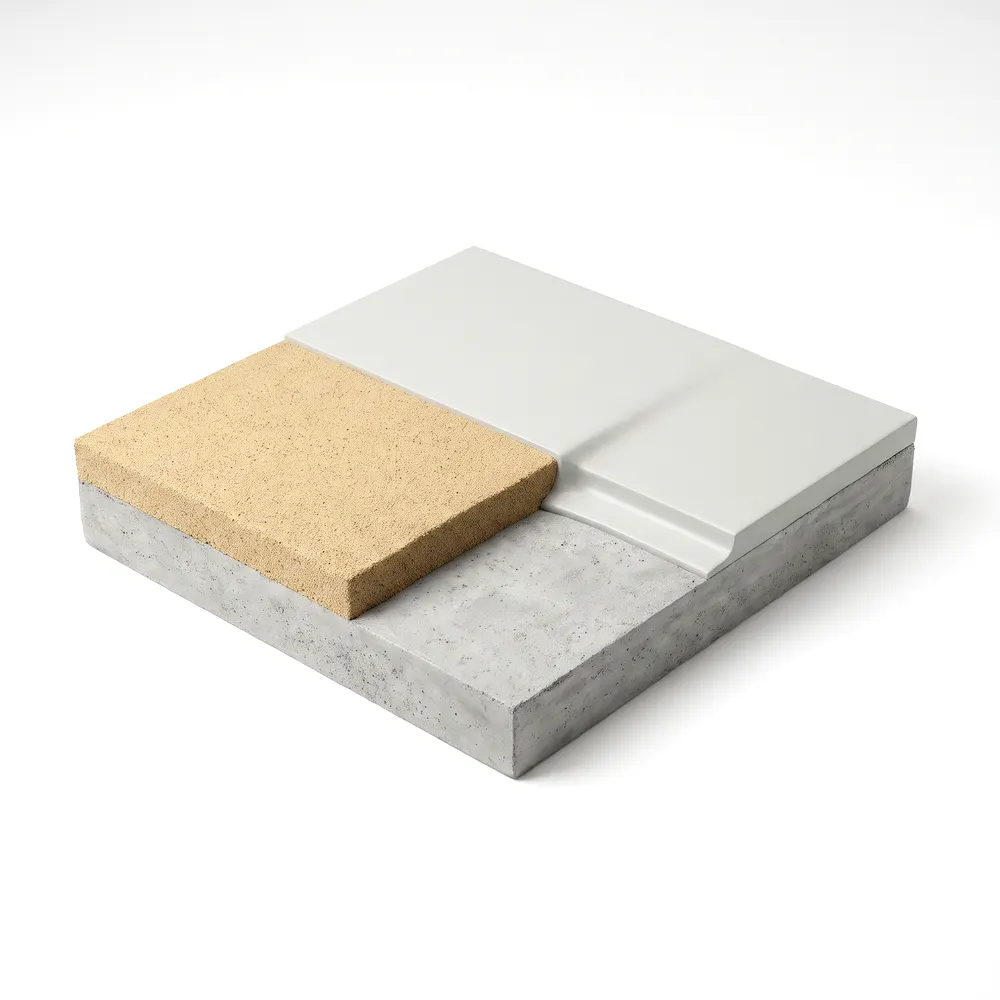
A floor that needs more than about 20 mm of build-up, or a slope to a drain, needs a sand and cement screed. A floor that is sound but a few millimetres out needs a self-levelling compound, poured 1 to 10 mm thick. The screed makes the level and then cures for weeks before tiling. The compound makes the surface flat and smooth, and can be tiled within hours.
In this guide
How many millimetres does the floor need to gain?
The choice is decided by depth, so measure how far the floor has to rise before buying anything. Lay a long straightedge across the room, or run a laser, and note the gap at the deepest hollows and the height the finished floor must reach at doors and drains.
A few millimetres of trowel ridges and shallow dips is a smoothing job for a self-levelling compound. Both compounds we stock are made for layers of 1 to 10 mm. Tens of millimetres, or a floor that must fall towards a drain, is a building-up job for a screed: a stiff sand and cement mortar that stays where the straightedge leaves it. A liquid compound cannot hold a slope, and poured that deep it is outside its data sheet. Many floors need both, screed first.
What is the difference between screed and self-levelling compound?
A screed is a mortar mixed and shaped on site; a self-levelling compound is a bagged powder that flows flat once water is added.
A screed is spread between level strips and struck off with a straightedge, so its quality depends on the sand, the water and the hand on the trowel. Mapei's sheet for the latex Planicrete SP covers screeds for interior and exterior use, and the same latex makes the slurry that bonds the screed to the slab. Commonly cited UK practice puts a bonded screed at 25 to 40 mm, in a mix of 1:3 to 1:4.5 cement to sand.
A compound comes in a bag: Ultraplan Eco 20 in 23 kg, Ultraplan Contract in 25 kg. Each is mixed with a measured amount of water and spread with a large metal trowel, then finds its own level and loses the trowel marks. Both sheets rule out exterior work.
Screed and self-levelling compound compared
The two differ most in thickness and in waiting time: a compound is a thin layer that can be tiled the same day, a screed a thick one that cures for weeks.
The compound times are minimums at +23°C, and both sheets say they vary with room temperature and humidity. On the humid coast, treat them as the earliest possible time, not a promise. Where a cell says not stated, the sheet gives no figure and we have not supplied one: Planicrete SP's sheet gives a cure before tiling, but none before vinyl or wood.
Quantities differ in kind too. A compound uses 1.6 kg/m² (Ultraplan Eco 20) or 1.7 kg/m² (Ultraplan Contract) per millimetre of thickness. A latex screed uses 1 kg of latex per square metre at 20 mm, plus cement and sand. Each product page has the data sheet and a coverage calculator.
| Point | Screed with Planicrete SP | Ultraplan Eco 20 | Ultraplan Contract |
|---|---|---|---|
| Thickness range | Minimum not stated; concrete mix above 50 mm | 1 to 10 mm per layer; 20 mm with quartz added | 1 to 10 mm per coat; 20 mm with sand added |
| What it is for | Level and falls to drains, inside or out | Smoothing interior floors; 3 mm minimum under chairs and trolleys | Smoothing interior floors; 3 mm minimum under wood |
| Wait before ceramic tiles | At least 28 days, or 1 week per cm | Minimum 3 hours | Minimum 3 hours |
| Wait before vinyl | not stated | Minimum 24 hours | Minimum 24 hours |
| Wait before wood | not stated | Minimum 48 hours | Minimum 24 hours |
| How it is laid | Stiff mortar, struck off between strips onto wet slurry | Metal trowel or squeegee; can be pumped | Metal trowel or rake; can be pumped |
Which to use at each depth
Use the compound up to 10 mm, the compound with added aggregate up to 20 mm, a bonded screed up to 50 mm and concrete beyond that. Those limits are the sheets' own; the list gives the detail.
Two cases sit to one side. Where a floor is flat overall with dips of a few millimetres, Keraflex Maxi S1 can take them up as tiles are fixed, since it can be applied up to 15 mm thick. That only works under tiles: vinyl and wood show every ripple beneath them and need the compound.
Where a floor needs depth and a fine finish, do both. Screed to within a few millimetres of level, let it cure, then pour the compound as the last layer. Dusty or very porous surfaces are primed first with Primer G.
- Up to 10 mm: compound in one layer, at least 3 mm under wheeled chairs (Ultraplan Eco 20) and under wood (Ultraplan Contract).
- 10 to 20 mm: about 30% by weight of 0.5 mm quartz added to Ultraplan Eco 20, or about 20 to 30% of 0/4 or 0/8 sand to Ultraplan Contract.
- 20 to 50 mm: a screed bonded to the slab, with compound on top if the finish needs it.
- Above 50 mm: a properly graded concrete mix designed for the job, as the Planicrete SP sheet says.
How long before tiles, vinyl or wood can go down?
On a self-levelling compound, hours; on a new sand and cement screed, weeks. That gap often decides a programme.
Both stocked compounds can take ceramic tiles after a minimum of 3 hours, and vinyl and other resilient floors after a minimum of 24 hours. Wood is where they part: 48 hours on Ultraplan Eco 20, 24 hours on Ultraplan Contract, which must then be at least 3 mm thick.
Mapei's Planicrete SP sheet says to let a screed harden and cure for at least 28 days, or 1 week per cm of thickness, before tile laying. The tile adhesive sheet agrees: cementitious screeds cured for at least 28 days, unless made with special binders. A young screed is still shrinking and giving up water, and tiles fixed rigidly on top are the ones that later sound hollow. If the programme cannot wait, the answer is a thinner build-up, not a shorter cure.
How to bond a new screed to old concrete
A new screed bonds through a cement and latex slurry on a prepared, dampened slab, with the screed laid while the slurry is still wet. Miss any part of that and the screed sits on the slab instead of gripping it, and sounds hollow when tapped.
Mapei's sheet warns against laying a screed onto slurry that has completely dried, and against using the latex neat as a slurry. Its mixing table gives the slurry as 1 part Planicrete SP to 1 part Portland cement, and the floor screed as 2 parts Portland cement to 6 parts dry sand, gauged with 1 part of latex first diluted 1:3 with water. On a hot slab, mix only as much slurry as the gang can cover with mortar before it dries. The steps follow the sheet.
- 1Sand and scarify the old concrete to remove loose particles and weak topping. New concrete must be at least 28 days old.
- 2Keep the surface continuously moist for at least 24 hours, then remove excess water until it is practically dry.
- 3Set gauging strips, sloped to drains where needed, and check levels.
- 4Sweep off residual water and apply the slurry just ahead of the mortar, at 0.3 kg of latex per square metre.
- 5While the slurry is wet, spread the mix between the strips with a metal straightedge and work it with a steel trowel.
- 6Finish to ±3 mm in 3 m, and keep general traffic off for at least 24 hours.
Neither a screed nor a compound cures damp. Both Ultraplan sheets exclude continuous rising damp, and Planicrete SP is not a waterproof membrane. Repair cracks first (the Ultraplan sheets name Eporip); a crack still moving, or a weak slab, needs an engineer.
Sources
- Ultraplan EC20 technical data sheet, Mapei (stocked as Ultraplan Eco 20)
- Ultraplan Contract technical data sheet, Mapei
- Planicrete SP technical data sheet, Mapei
- Keraflex Maxi S1 technical data sheet, Mapei
- Screed, Designing Buildings (secondary source for commonly cited UK screed thicknesses and mixes)
Written by Sahihi Construction Chemicals Limited, Dar es Salaam. Product figures are quoted from the manufacturers' technical data sheets; check the current sheet before you specify.