Tiling6 min read
Tile adhesive or sand and cement: which to use
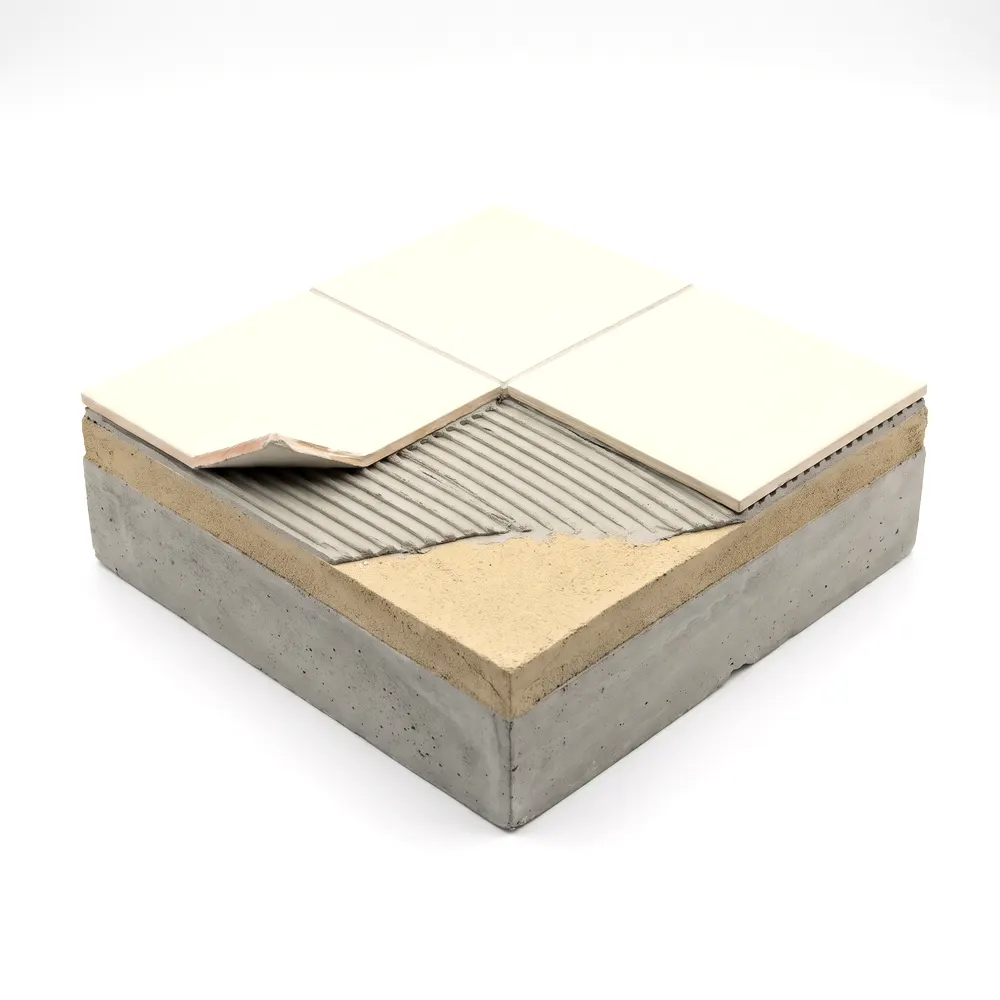
Use tile adhesive to fix the tile, and sand and cement to build up the floor beneath it. A thin bed of classified adhesive is tested for bond, and it is what porcelain and large tiles need, because they give a site mix little to grip. Sand and cement still earns its place as a levelling screed, cured first, with adhesive on top. Adhesive costs more per bag, but it uses far less material.
In this guide
- 1Are tile adhesive and sand and cement two versions of the same thing?
- 2Tile adhesive and sand and cement compared
- 3Why do porcelain and large tiles need adhesive?
- 4What does a classified adhesive promise that a site mix does not?
- 5When is a sand and cement screed still the right first step?
- 6Is tile adhesive more expensive than sand and cement?
Are tile adhesive and sand and cement two versions of the same thing?
No. They are two different methods, and most mistakes come from treating one as a cheaper copy of the other.
Fixing on sand and cement is a thick-bed method. The fundi mixes mortar on site, spreads it and beds each tile into it, so the bed does two jobs at once: it levels the floor and holds the tile. Plenty of floors have been laid this way.
Tile adhesive is a thin-bed method. The bag holds a factory blend. Mapeset, for example, is cement, graded sands, synthetic resins and additives, and it only needs a measured amount of water. It is combed on with a notched trowel and does one job, holding the tile. That leaves the floor beneath with the job of being flat, which is why the two materials so often end up on the same site.
Tile adhesive and sand and cement compared
The site mix wins on depth; the adhesive wins on nearly everything to do with the bond. A site mix has no data sheet, so its strength depends on the sand, the cement, the water and the hand on the shovel. You will find articles printing bond strength figures for sand and cement. We could not trace those figures to a test, so we print none.
The adhesive's weak point is time. Open time is about 20 minutes for Mapeset, Kerabond T and Adesilex P7, and over 30 minutes for Keraflex Maxi S1. Mapei warns that strong sun, drying wind and high temperature can cut this to just a few minutes. On a hot roof slab, cool the surface with water and comb out small areas. If the adhesive has skinned, do not wet it. Re-trowel it or replace it.
| Sand and cement bed | Classified adhesive | |
|---|---|---|
| Bed thickness | Thick, set by hand; varies by mix | 2 to 5 kg/m² by trowel; up to 15 mm on two products |
| Tiles it suits | Absorbent tiles with pores to grip | By class, up to large porcelain |
| How it bonds | Cement paste working into the tile back | Cement and synthetic resins |
| Tested for | Nothing: no class, no data sheet | Adhesion after water, heat and freeze-thaw |
| What goes wrong | Voids, shrinkage, dense tiles letting go | Skinned bed, uncured screed, wrong class |
Why do porcelain and large tiles need adhesive?
Because a site mix relies on something porcelain does not offer, and large tiles punish any weakness in the bed. Cement mortar holds a tile largely by its paste working into the pores of the tile back. Porcelain is dense, with very little for the paste to work into, so the mortar can harden against the back without really holding it.
Size adds to the problem. A thick bed shrinks as it dries, that strain goes into the tile, and any voids become long hollow patches under a big one.
The data sheets draw these lines themselves. Adesilex P7 is made for ceramic and porcelain. Keraflex Maxi S1 is especially suited to large porcelain, and it is classed deformable. Not every bag qualifies, though. Mapeset excludes large format tiles, and Kerabond T excludes non-absorbent tiles on non-absorbent substrates.
What does a classified adhesive promise that a site mix does not?
A measured minimum bond, checked after the conditions a floor actually meets. Tanzania has its own document for these adhesives, Tanzanian standard 1434-1:2011 from TBS, which covers cementitious, dispersion and reaction resin types. We have read its record, not its full text.
The class tables we have read are in FDKS 2129-1:2023, a Kenyan public review draft using the same codes. A C1 adhesive must reach at least 0.5 N/mm² in tensile adhesion, and a C2 at least 1 N/mm², initially and after water immersion, heat ageing and freeze-thaw.
Those are minimums for the class. The sheets print 1.0 N/mm² initial adhesion for Mapeset and 1.4 N/mm² for both Kerabond T and Adesilex P7, all after 28 days. Kerabond T shows why a number alone is not enough: it is still a C1T with limits on where it goes. Read the code, then the "do not use" list.
When is a sand and cement screed still the right first step?
Whenever the floor needs real depth, or a fall to a drain. Adesilex P7 and Keraflex Maxi S1 go to 15 mm on irregular substrates and Kerabond T stops at 5 mm, and none of them will form a slope across a wet room.
The sound method separates the jobs: sand and cement makes the level, adhesive holds the tile. The cost is waiting. Mapei's sheets ask for cement screeds to cure for at least 28 days in mild weather before tiling, because tiles fixed on a screed that is still shrinking are the ones that later sound hollow. During the masika rains, check that the screed is actually dry and do not simply count days.
Where the floor is sound and only a few millimetres out, skip the screed. Ultraplan Eco 20 is a self-levelling compound for interior floors, 1 to 10 mm per layer.
- 1Bond the screed to the prepared slab with a cement slurry. Planicrete SP is the latex for it, always mixed with Portland cement.
- 2Lay the screed to level, with falls to any drains.
- 3Cure it for at least 28 days.
- 4Check it is flat and dry, then fix the tiles in a thin bed of the right class.
Is tile adhesive more expensive than sand and cement?
Per bag, yes; for the whole floor, it depends what you count. Work out the adhesive in bags per square metre. Mapeset and Adesilex P7 with a No. 5 trowel use 2.5 to 3 kg/m², so a 25 kg bag covers 8.3 to 10 m² (25 / 3 and 25 / 2.5). Each product page has the data sheet and a coverage calculator.
For the site mix, count the cement, the sand and the labour at your thickness, along with the weight on a suspended slab and the height at the door. We give no general figure for that side, because it depends on the depth and the mix. The other line in the sum is a floor that lifts: new tiles, labour and the room out of use. Once you have decided on adhesive, choose by tile and place.
- Mapeset (C1): absorbent ceramic tiles and mosaics. Not for large format.
- Kerabond T (C1T): ceramic tiles and mosaics, no vertical slip, bed up to 5 mm.
- Adesilex P7 (C2T): ceramic and porcelain, tile on tile up to 900 cm².
- Keraflex Maxi S1 (C2TES1): large porcelain and suitable stone, longer open time.
Sources
- Mapeset technical data sheet, Mapei
- Kerabond T technical data sheet, Mapei
- Adesilex P7 technical data sheet, Mapei
- Keraflex Maxi S1 technical data sheet, Mapei
- Planicrete SP technical data sheet, Mapei
- Ultraplan EC20 technical data sheet, Mapei (stocked as Ultraplan Eco 20)
- FDKS 2129-1:2023, Kenya Bureau of Standards, public review draft
- Tanzanian standard 1434-1:2011, Tanzania Bureau of Standards, regulation record
Written by Sahihi Construction Chemicals Limited, Dar es Salaam. Product figures are quoted from the manufacturers' technical data sheets; check the current sheet before you specify.